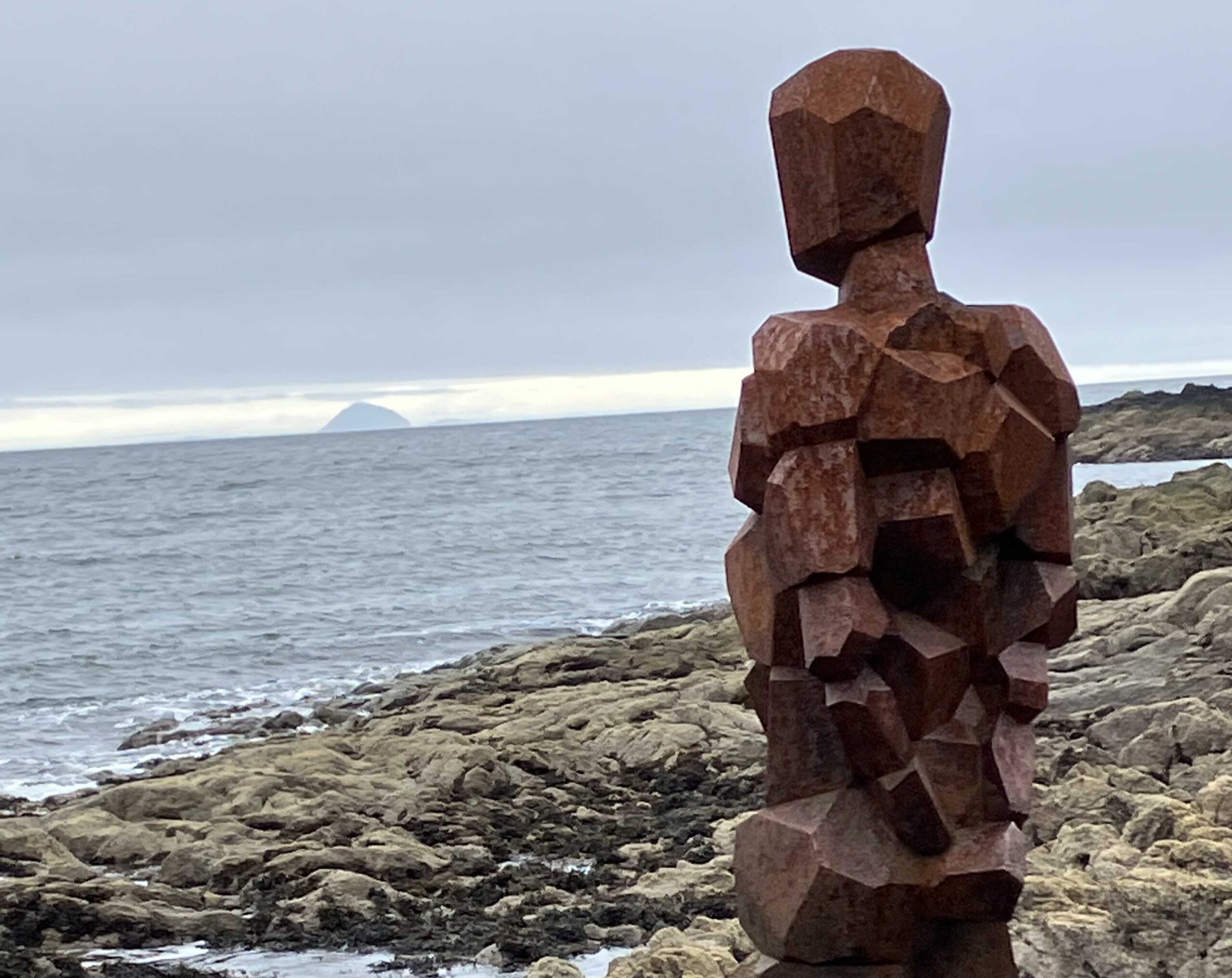
GRIP is a sculpture created for Saddell Bay on the Kintrye Peninsula by artist Antony Gormley
Jeremy Lent’s most recent book will be as inspiring as his previous works The Web of Meaning and The Patterning Instinct. The extensive promotion material for the forthcoming book on Eco-Civilisation suggests that it will repeat an assumption about the evolution of the human species that I think is questionable, misleading, inaccurate and, more importantly, dangerous.
The assumption is found in many recent popular books about human evolution. Fukuyama in The Origins of Political Order considers that nomadic hunter gatherers had no concept of private property or incentive to mark out a plot. Jared Diamond in The World /Until Yesterday contends that small bands that lived up to 11, 000 years ago were just a few dozen or so, leading a simple life without economic specialization; the only time humans lived with some sort of social harmony and equality. In the best-selling book Sapiens: A Brief History of Humankind Yuval Noah Harari claims that during the hunter-gatherer era ‘members of a band knew each other very intimately and were surrounded throughout their lives by friends and relatives’. He contends that small bands that lived up to 11,000 years ago were just a few dozen or so, leading a simple life without economic specialization. This was the only time humans lived with some sort of social harmony and equality. In The Patterning Instinct, Jeremy Lent writes:
Hierarchies and wealth. Property and land ownership. These things seem like they’ve been part of human experience since time immemorial, but we’ll see that that is not the case. These new notions only arose when foragers began settling in one place, beginning about 10,000 years ago..
Most recently, Luke Kemp’s Goliath’s Curse, promoted as a ‘radical retelling of human history’, assumes the same story. For most of history, people lived in little bands and were ‘egalitarian’. More sedentary groups, bigger populations and agriculture and surplus products caused the inevitable rise of inequality and hierarchy. Kemp goes as far as to picture how our ancestors wandered ‘out of Africa into the wider world in sociable, well-connected, egalitarian nomadic bands’ .
The archaeologists, David Graeber and David Wengrow in The Dawn of Everything look at the evidence behind these assumptions. They find it frustrating that the myth continues. For example, they think David Boehm has a great insight in finding that a distinctive aspect of the human species is the ability not to do something, or to shame another not to do something. But they cannot understand why this leads to the supposition that over thousands of generations all humans tended to follow the same arrangements, in Boehm’s words: ‘egalitarian for thousands of generations before hierarchical societies began to appear’.
Graeber and Wengrow painstakingly go through the evidence which indicates that human societies before the advent of farming were not confined to small, egalitarian bands. They go as far as to claim that ‘almost everyone who isn’t a Pleistocene archaeologist – that is, who is not forced to confront the evidence -simply ignores the evidence and writes as if hunter-gathers have lived in a state of primordial innocence’. Why do they ignore, for instance, stone temples, elaborate princely burials, massive monuments and thriving centres of trade going back into the Ice Age?
Why does this all this matter? It might be a questionable or misleading assumption (romantic or naïve perhaps) but what makes it ‘dangerous’? The assumption props up a story that there was a time of harmonious living together. It is used to support the argument that ‘human nature’ is not inherently acquisitive, materialistic or greedy, that it does not necessarily lead to hierarchy, power structures and an elite that accumulates wealth. But at the same time, it is implying that there is a human nature that we can draw on that is fair, caring and sociable (– perhaps something comparable to that shown in the animal kingdom in the protective behaviour towards cubs or fledgling birds).
My question is what if we do not take sides? What if there is no human nature? What if it is not inherently good or bad? Humans are distinctive but not inherently so. As David Boehm investigated, we seem to be the only species that can decide not to do something. At the same time, we are distinctive in becoming parasitical and, through our decisions, perhaps lead our species to our extinction. We are likely to face increasing world-wide barbarity triggered by the chaos caused by climate change and damage to eco-systems.
But then, are we being too human-centred? We are very recent arrivals on this planet, let alone the universe. We think we are so important. We even suggest we should ‘save the world’. The world will recover whatever our legacy.
I am reminded of a point made by Wildcat, a Yuchi member of the Muscogee Nation of Oklahoma, and professor at Haskell Indian Nations University: ‘our lives are essentially not about us’; they are about our place in the ‘totality of living things.’
Some of us think life is about accumulating wealth, status, power, property, land. Many aspire to increase cultural capital for themselves and their children. Others are concerned to ensure ‘human flourishing’, well-being, a higher state of spiritual-consciousness, or what might be called ‘spiritual capital’. While we seek our goals, millions live in the global south and north at different levels of poverty, homelessness, hunger, abuse, danger and exploitation. This is not just about inequality (which is something highlighted by those who assume we were once egalitarian), it involves pervasive forms of mostly hidden colonialism, with the lives of many dependent on the abuse, exploitation, injury and death of others in different parts of the world.
In my 70s, I feel the need to unsettle the many comforting stories, easy targets, notions that have sprung from my insulated life so far. In terms of Michel Serres’ philosophy, perhaps, I want to be a parasite that disturbs, breaks up, intervenes, questions, disrupts. As Lynn Margulis understood, symbiosis is fundamental, but we need to remember that we would not be here without the role of parasites (eg viruses) that are an integral part of the process of symbiosis. The great leaps in evolution did not occur through simple collaboration. They were accidental or caused through struggle, conflict, war and peace.
0 Comments